
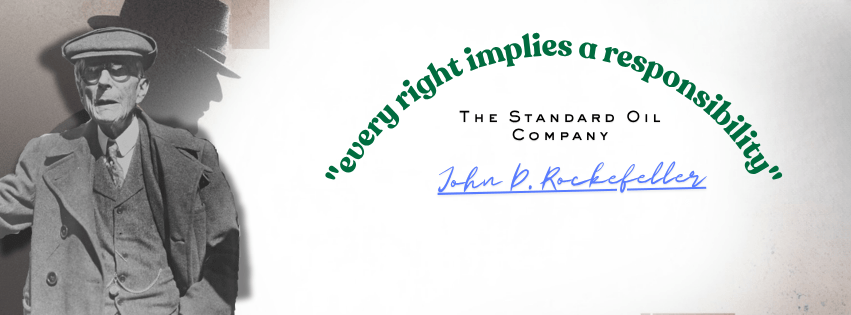
Established by John D. Rockefeller, his brother William, and Henry M. Flagler, the company aimed to dominate the oil refining industry without initially offering public stock. Standard Oil’s operations were marked by a focus on large-scale production, controlling a substantial portion of the United States’ refining capacity and utilizing innovative practices for efficiency and cost-saving.
“Much that one man cannot do alone we can do together, and once admit the fact that cooperation, or what is the same thing, combination, is necessary on a small scale, the limit depends solely on the necessities of business. Two persons in partnership may be a sufficiently large combination for a small business, but if the business grows, or can be made to grow, more persons and more capital must be taken in it.”
— Testimony of John D. Rockefeller, President of The Standard Oil Company, before the Industrial Commission (1899)
During the 1870s–1890s, Standard Oil absorbed many small and large oil companies and established regional companies across the USA.
From 1880 to 1900, oil prices remained stable at about $1 per barrel, lower than the prices both before and after this period. This suggests that the expansion of markets through cheap oil, rather than high oil prices, financially fueled the growth of Standard Oil.
The period from 1890 to 1914 is often called the Progressive Era in American history, characterized by reforms supporting the middle class, science and education, women’s rights, social liberties, anti-corruption, and “trust-busting” policies. In David Chalmers’ edition of Ida Tarbell’s work, he wrote:
“They fought their way to control by rebate and drawback, bribe and blackmail, espionage and price cutting, and perhaps even more important, by ruthless, never slothful efficiency of organization and production.”
Yet, Rockefeller testifying:
“Every step taken was necessary in the business if it was to be properly developed, and only through such successive steps and by such combination is America today enabled to utilize the bounty which its land pours forth, and to furnish the world with the best and cheapest light ever known, receiving in return therefor from foreign lands nearly $50,000,000 dollars per year, most of which is distributed for payment of American labor.”
— Testimony of John D. Rockefeller, President of The Standard Oil Company, before the Industrial Commission (1899)
In July 1911, Standard Oil announced its new structure: it would split into 33 companies, some large and some small. In doing so, the organization ensured that these new entities shared the market rather than competed with one another, which was to be expected.


Leave a comment